


How to Choose the Best Robotic Automation Systems in 2026?
In 2026, choosing robotic automation systems is less about buying the fastest arm and more about matching technology to real work. A compact collaborative robot may suit a crowded assembly bench, while a high-speed robot may fit a guarded packaging line. The right choice depends on cycle time, payload, reach, accuracy, and the parts workers handle every day. A vision camera can help locate uneven components, but it also adds setup and maintenance needs. Small details matter. Joseph Engelberger, a pioneer of industrial robotics, once said, “I can’t define a robot, but I know one when I see one.” His observation captures a practical challenge: specifications alone rarely reveal whether a system will work well on your floor. Good selection means examining the full task, not just the machine.
Begin by documenting the process, including awkward part shapes, changeovers, and the time operators spend clearing jams. Then compare systems for integration, safety features, programming demands, service access, and total operating cost. Ask vendors to demonstrate your actual parts and production sequence, not a polished sample task. Measure the result. A convincing demo is useful, but it does not prove reliable performance across shifts or product changes. Check whether local support can provide spare parts and technician response when needed. Also consider training; a system nobody can adjust confidently may become an expensive bottleneck. Even a careful shortlist can miss something. That is worth admitting early. The following guide breaks down the questions, trade-offs, and evaluation steps that help buyers choose robotic automation systems with clearer expectations in 2026.
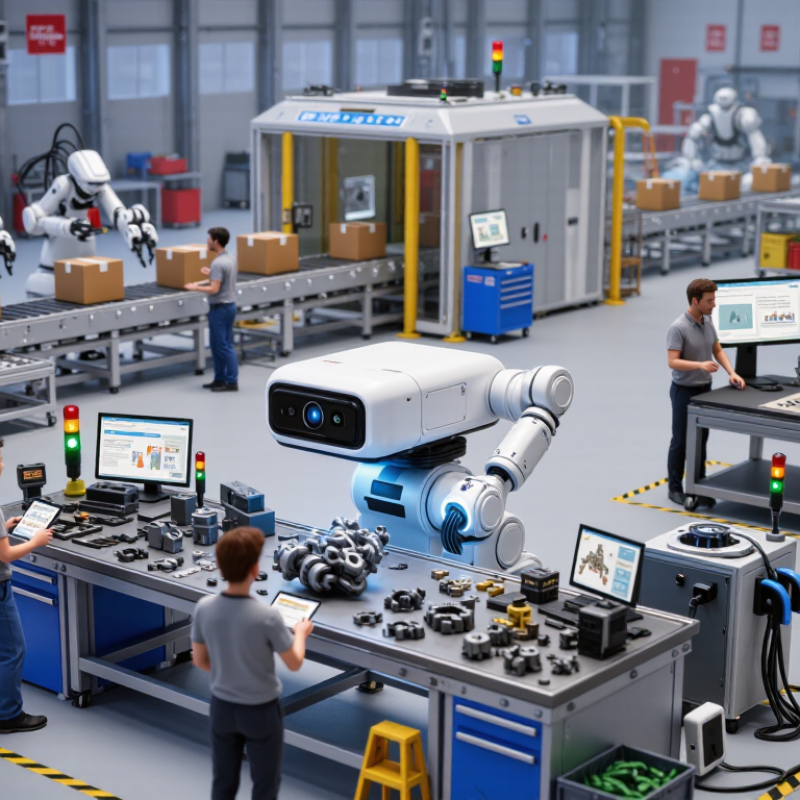
Define Your Automation Goals and Operating Requirements
Before comparing robotic systems, define the job in measurable terms. Set a target cycle time, daily volume, acceptable downtime, and quality threshold. Then document the real operating conditions: part weight, grip points, reach, floor space, shift length, and product changes. A robot lifting a 12-kilogram part every 40 seconds faces different demands from one handling light, varied components. Start with the constraint. Observe the process across busy and quiet shifts; averages can hide jams, rework, and awkward handoffs. Some initial targets will be wrong. That is useful if you test them against actual production data.
The International Federation of Robotics reported 541,302 industrial robot installations worldwide in 2023, with 4,281,585 units operating globally, in World Robotics 2024. These figures show broad adoption, not guaranteed returns for any single facility. Build a site-specific baseline before setting payback expectations. Record labor time, changeover duration, defect rates, and unplanned stops. Specify how the system must connect with existing conveyors, sensors, and production software. Include operator access, maintenance space, and safe recovery after a fault. A clean test cell can mislead. Validate the proposed workflow with representative parts and realistic cycle conditions, and note where manual judgment still matters.
How to Choose the Best Robotic Automation Systems in 2026? - Define Your Automation Goals and Operating Requirements
| Decision Dimension | Example Operating Requirement | Suitable System Type | What to Verify Before Selection | Acceptance Measure |
|---|---|---|---|---|
| Task and process | Pick and place identical components between a conveyor and a fixture. | Six-axis industrial arm or SCARA robot, depending on required motion and workspace. | Part orientation, gripping method, tool changes, part variation, and required access angles. | Complete a representative production run with the actual parts and end effector. |
| Production volume | Process 600 units during an 8-hour shift, allowing for planned breaks and changeovers. | Robot cell sized to the process; a dedicated fixed cell may suit stable, repeatable work. | Include loading, unloading, inspection, robot motion, stoppages, and planned downtime in the cycle-time model. | Demonstrate the required good-part output over a sustained trial, not just a single cycle. |
| Payload and reach | Handle a 12 kg workpiece using a 3 kg gripper, with access to fixtures across a 1.2 m work area. | Robot selected for the combined tool-and-part load and the required reach; alternatives may include a Cartesian system. | Check payload at the required wrist orientation, center of gravity, reach, mounting position, and cable routing. | Confirm the complete motion path is within the manufacturer’s rated limits for the selected configuration. |
| Accuracy and repeatability | Place parts within a process tolerance of ±0.5 mm at the fixture. | Industrial robot, SCARA, or Cartesian system, selected according to the motion geometry and tolerance. | Distinguish robot repeatability from overall cell accuracy; include calibration, fixture, vision, and part tolerances. | Measure placement results across repeated cycles using the production fixture and measurement method. |
| Layout and mobility | Move materials between several workstations where routes and work locations may change. | Autonomous mobile robot for transport; a fixed robotic cell for operations at a stable station. | Assess aisle width, floor condition, traffic, load-transfer points, charging, and interaction with people. | Complete route trials under representative traffic and verify reliable delivery at each handoff point. |
| Operating environment | Run in a production area with dust, temperature changes, and regular washdown nearby. | Robot and cell components rated for the actual site conditions; enclosure or protective measures may be required. | Check environmental ratings for the robot, controller, sensors, gripper, connectors, and electrical cabinet separately. | Confirm documented ratings and validate operation under the site’s expected conditions. |
| Integration and changeovers | Exchange status and production data with an existing programmable logic controller and manufacturing system. | Robot cell with compatible industrial communications and clearly defined interface responsibilities. | Confirm supported protocols, signal lists, recipe handling, fault recovery, data ownership, and changeover procedure. | Test normal operation, changeover, restart, and fault recovery using the intended production interfaces. |
| Safety and human access | Operators load parts near the cell and may need access for setup and maintenance. | Safeguarded robot cell; collaborative operation is an application-specific design choice, not a substitute for risk assessment. | Complete a risk assessment covering tooling, workpiece, speed, contact hazards, access, and foreseeable misuse. | Verify safeguards and safety functions before production; apply relevant local regulations and standards. |
| Business case and support | Reduce repetitive manual handling while meeting the site’s required output and quality levels. | Compare complete cell options, including robots, tooling, integration, guarding, training, and service. | Estimate total installed cost, labor impact, maintenance, spare parts, energy, training, and expected production gains. | Approve a documented payback model and confirm local technical support and spare-parts availability. |
Example planning scenario: requirements and acceptance measures should be adjusted to the actual parts, process, site conditions, and applicable safety rules. Robot capabilities vary by model and configuration.
Related Posts
-

Why Choose Robotic Automation Systems for Your Business?
-
10 Tips for Choosing Industrial Automation Solutions
-
What Are the 2026 Top Industrial Digitalization Systems?
-
How to Choose Industrial Automation Solutions?
-
China Top 10 Industrial Digitalization Systems Suppliers
-
Top 10 Industrial Automation Equipment Suppliers Worldwide?