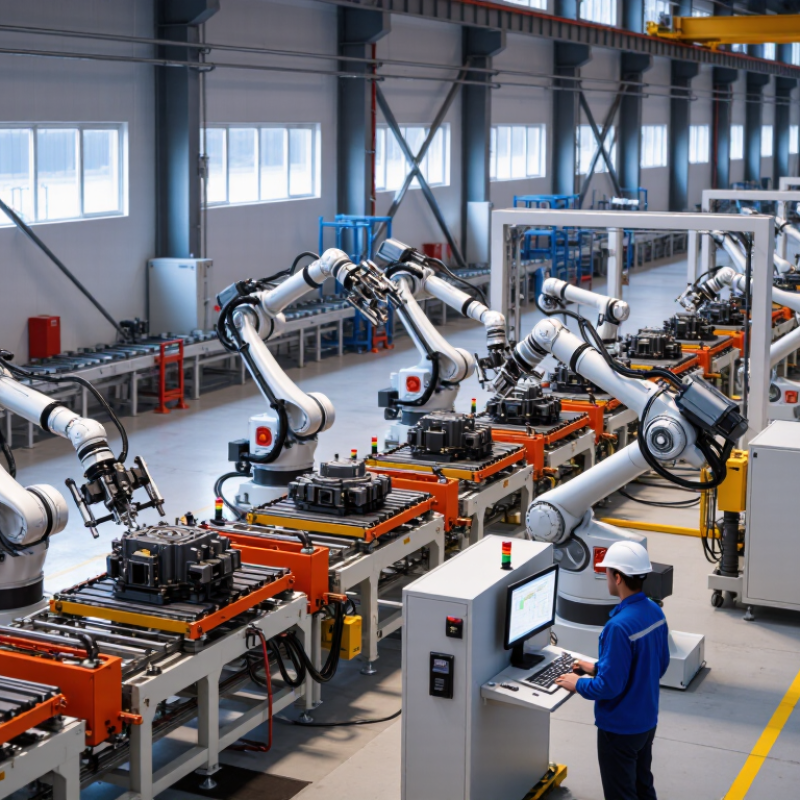
| Robotic Assembly and Handling Systems |
Part loading, pick-and-place, screwdriving, dispensing, palletizing, and repetitive assembly operations. |
Repeatability, cycle time, payload, uptime, safety, and changeover flexibility. |
Payload capacity, working envelope, positioning repeatability, cycle time per operation, end-of-arm tooling, vision capability, and line integration interface. |
ISO 10218 for industrial robot safety, ISO/TS 15066 for collaborative robot applications where relevant, machinery risk assessment, guarding, and emergency-stop requirements. |
Approximately 12–28 weeks for a configured system, depending on tooling, controls, testing, and site integration. |
Verify spare-parts availability, preventive-maintenance intervals, operator training, remote diagnostics, and the availability of replacement safety components. |
Can the supplier demonstrate the required cycle time using production-representative parts? What is included in factory acceptance testing and site acceptance testing? |
| Automated Inspection and Machine-Vision Systems |
Dimensional inspection, surface defect detection, presence checks, barcode reading, and process verification. |
Detection accuracy, false-reject rate, inspection speed, lighting stability, and traceability. |
Camera resolution, field of view, lens configuration, lighting method, inspection cycle time, measurement uncertainty, data-storage capacity, and reject-handling method. |
ISO 9001 quality-management practices, calibrated measurement procedures, electrical safety requirements, and applicable cybersecurity and data-integrity controls. |
Approximately 8–20 weeks for standard configurations; complex optics, custom algorithms, or multi-station systems may require longer. |
Assess recipe-management controls, calibration schedules, software-update policy, replacement-camera compatibility, and production-data export formats. |
What are the validated detection limits? How are lighting variation, product tolerances, reflective surfaces, and false rejects controlled? |
| Precision Motion-Control Platforms |
Multi-axis positioning, electronic assembly, dispensing, laser processing, laboratory automation, and high-accuracy manufacturing. |
Accuracy, repeatability, acceleration, vibration control, thermal stability, and synchronization. |
Axis travel, positional accuracy, repeatability, maximum speed, acceleration, payload, backlash, controller interpolation rate, and feedback resolution. |
IEC 61800 for adjustable-speed electrical power-drive systems, machinery safety requirements, electromagnetic compatibility, and applicable electrical installation codes. |
Approximately 8–18 weeks for standard motion platforms and 16–30 weeks for customized multi-axis systems. |
Review lubrication requirements, encoder replacement procedures, alignment checks, controller obsolescence planning, and environmental operating limits. |
Are accuracy values specified under defined temperature, payload, speed, and mounting conditions? Is a measurement report provided at acceptance? |
| Industrial Control and Automation Panels |
Machine sequencing, process control, motor management, safety interlocking, data collection, and production-line coordination. |
Control reliability, network compatibility, safety integrity, maintainability, and expandability. |
Input/output count, processing capacity, scan time, network protocols, enclosure rating, short-circuit protection, safety functions, and spare capacity. |
IEC 60204-1 for electrical equipment of machinery, IEC 61439 for low-voltage switchgear assemblies where applicable, EMC requirements, and local electrical codes. |
Approximately 6–16 weeks for engineered panels, subject to component availability, wiring complexity, and testing requirements. |
Require readable schematics, labeled wiring, backup programs, password ownership, component lifecycle information, and documented modification procedures. |
Will the buyer receive complete electrical drawings, software backups, network architecture, parameter lists, and a clear change-control process? |
| Conveyor and Intelligent Material-Handling Systems |
Unit-load transport, sorting, accumulation, buffering, packaging, warehouse transfer, and production-line feeding. |
Throughput, product protection, accumulation control, energy consumption, and availability. |
Rated load, conveyor speed, usable width, transfer accuracy, accumulation capacity, noise level, incline angle, sensor configuration, and emergency-stop coverage. |
Machinery guarding requirements, electrical safety standards, workplace ergonomics, load-handling rules, and site-specific fire and building codes. |
Approximately 8–22 weeks, depending on conveyor length, structural design, controls, installation, and integration with upstream and downstream equipment. |
Evaluate belt or roller replacement time, access for cleaning, wear-part stock, inspection points, energy use, and the availability of maintenance procedures. |
What is the guaranteed throughput under the actual product mix? How are jams detected, isolated, cleared, and recorded? |
| Digital Twin and Production-Simulation Services |
Line balancing, capacity planning, virtual commissioning, layout validation, bottleneck analysis, and operator training. |
Model accuracy, scenario coverage, data quality, interoperability, and measurable decision value. |
Model scope, simulation time step, equipment libraries, production logic, data interfaces, calibration method, scenario count, and reporting functions. |
Information-security controls, data-governance requirements, software access management, and documented model-validation procedures. |
Approximately 4–16 weeks for an initial model, depending on data readiness, process complexity, and the required level of detail. |
Confirm ownership of the model, source files, assumptions, user licenses, update responsibilities, and the method used to validate simulated results against production data. |
Which measured production data will calibrate the model? What level of prediction error is acceptable for capacity and cycle-time decisions? |
| Condition Monitoring and Predictive-Maintenance Systems |
Monitoring of motors, pumps, gearboxes, bearings, compressors, fans, and other rotating or critical assets. |
Signal quality, early-warning capability, alarm reliability, asset coverage, and maintenance impact. |
Sensor types, sampling frequency, measurement range, battery life, communication method, alarm thresholds, data retention, and integration with maintenance systems. |
IEC 62443 principles for industrial cybersecurity where connected systems are used, electrical safety, radio requirements, and asset-specific measurement standards. |
Approximately 4–12 weeks for pilot deployments and 8–20 weeks for multi-asset installations. |
Review sensor calibration, battery replacement, data ownership, alert escalation, cybersecurity updates, and the process for confirming whether an alert represents a genuine fault. |
Can the supplier provide documented evidence that alarms correlate with actionable failure modes rather than merely reporting abnormal readings? |
| Custom End-of-Arm Tooling and Process Fixtures |
Gripping, welding, dispensing, assembly positioning, clamping, testing, and component orientation. |
Grip reliability, part protection, repeatability, quick changeover, and maintainability. |
Part range, gripping force, tooling mass, allowable payload, positional repeatability, cycle rate, sensors, pneumatic or electric requirements, and wear-part life. |
Machinery safety, pneumatic safety, electrical safety, risk assessment, and application-specific requirements for welding, dispensing, or pressure systems. |
Approximately 4–14 weeks for standard tooling and 10–24 weeks for complex custom fixtures. |
Check replaceable contact surfaces, spare-jaw availability, adjustment procedures, cleaning access, documented setup values, and compatibility with future product variants. |
Has the tooling been tested across the full dimensional and material variation expected in production? What happens after loss of air, power, or communication? |
| Automated Test and Functional-Verification Equipment |
Electrical testing, leak testing, pressure testing, torque verification, functional checks, and end-of-line validation. |
Measurement capability, repeatability, test coverage, throughput, traceability, and operator safety. |
Test range, accuracy, resolution, gauge repeatability and reproducibility, cycle time, fixture life, calibration interval, data format, and pass/fail logic. |
Applicable electrical, pressure, calibration, product-safety, and machinery standards; measurement equipment should be controlled through a documented calibration system. |
Approximately 8–24 weeks, depending on test complexity, calibrated instrumentation, fixtures, software, and validation requirements. |
Require calibration certificates, uncertainty information, controlled test recipes, audit trails, user permissions, and procedures for managing failed or suspect test equipment. |
What evidence proves that the test system can distinguish conforming from nonconforming products across the complete specification range? |
| Energy-Efficient Pneumatic and Hydraulic Automation |
Clamping, pressing, lifting, actuation, forming, motion assistance, and process-force applications. |
Force control, leakage performance, response time, energy use, safety, and serviceability. |
Operating pressure, flow rate, force, stroke, response time, duty cycle, leakage rate, filtration requirements, noise level, and safety-relief functions. |
ISO 4413 for hydraulic fluid power, ISO 4414 for pneumatic fluid power, machinery safety, pressure-equipment requirements, and local installation regulations. |
Approximately 6–18 weeks for standard assemblies and 12–26 weeks for engineered systems with custom manifolds or force-control requirements. |
Assess leak testing, filter and seal replacement intervals, energy-monitoring capability, lockout procedures, pressure-release provisions, and availability of service kits. |
What is the expected energy consumption per operating cycle? How are stored energy, unexpected movement, and pressure loss safely managed? |
| Engineering, Integration, and After-Sales Support |
System design, mechanical and electrical integration, commissioning, validation, documentation, training, and long-term technical support. |
Requirement compliance, project governance, commissioning quality, response time, and total cost of ownership. |
Design-review gates, acceptance criteria, documentation package, training hours, installation scope, warranty period, support hours, escalation process, and spare-parts strategy. |
ISO 9001 quality processes, machinery risk assessment, applicable regional conformity requirements, cybersecurity controls, and site safety procedures. |
Project schedules commonly range from 10–40 weeks, depending on scope, customization, site readiness, and validation requirements. |
Compare warranty coverage, response-time commitments, local service capability, software and drawing ownership, training materials, and end-of-life support provisions. |
Which deliverables are included in the contract? Who owns the source code, drawings, recipes, passwords, test data, and future modification rights? |